
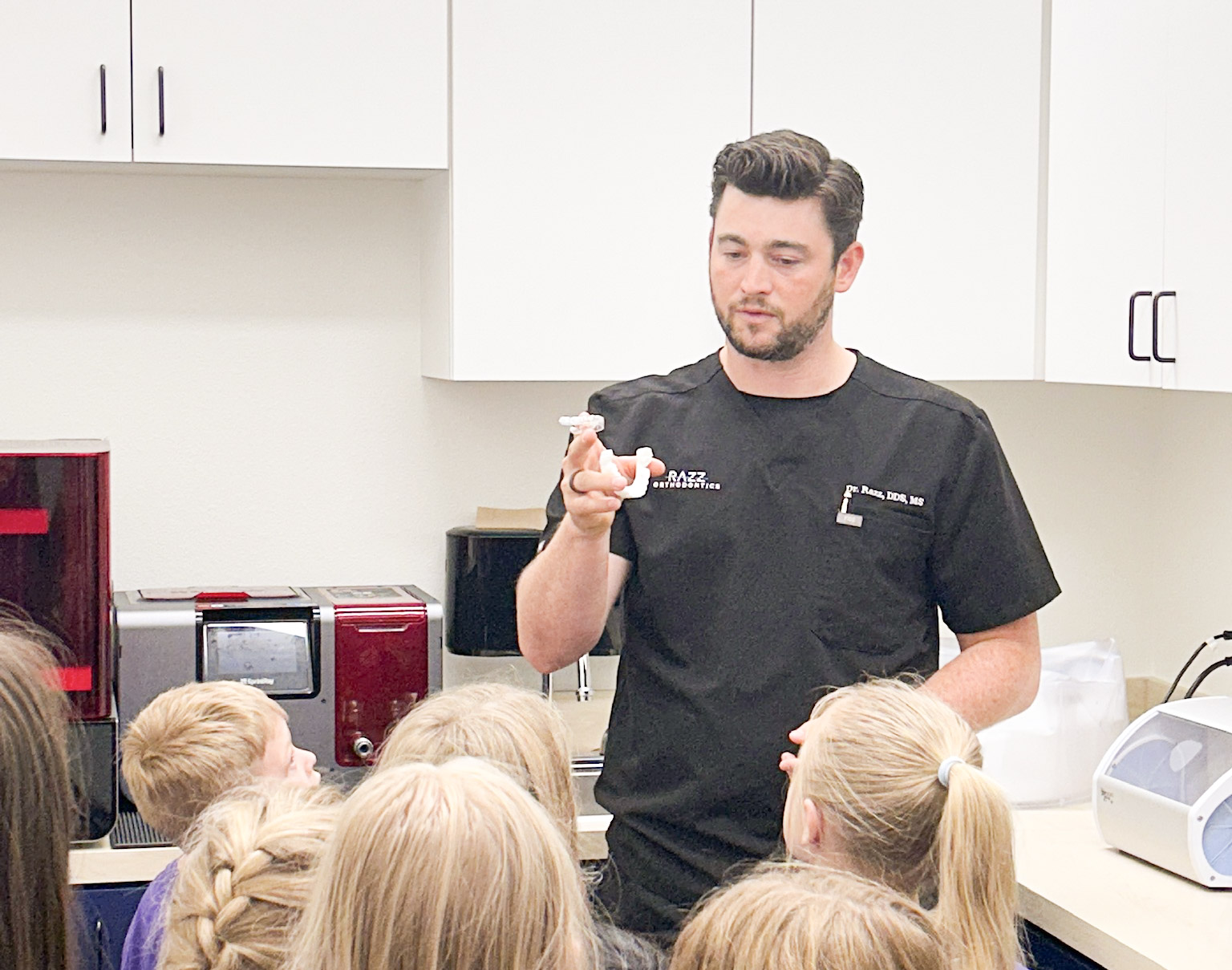
What In-Office 3D Printing Means for Your Orthodontic Treatment
Orthodontics has changed dramatically over the last decade, and one of the biggest shifts happening right now is in-office 3D printing moving from off-site labs into the practice itself. At Razz Orthodontics, this technology shapes how we design, produce, and deliver appliances for the patients and families we care for in Flower Mound. Here’s what in-office 3D printing actually means for your treatment, your comfort, and your results.

What Is In-Office 3D Printing in Orthodontics?
In-office 3D printing in orthodontics is the chairside fabrication of custom appliances (like aligners, retainers, and bonding trays) using digital scans and a dental-grade 3D printer located inside the practice. Instead of shipping physical molds to an outside lab and waiting weeks, your appliance is designed, printed, and finished in-house.
The workflow starts with an intraoral scanner that captures a detailed 3D image of your teeth and gums. That scan flows into treatment planning software, where Dr. Razz designs the appliance digitally. The design file is then sent straight to a resin-based 3D printer sitting a few feet away from your chair.
Common outputs from this workflow at Razz Orthodontics include:
- Clear aligners and Spark aligner refinements
- Retainers for the Lifetime Confidence Program
- Indirect bonding trays for precise bracket placement
- Study and surgical planning models
- Custom orthodontic appliances for two-phase treatment
The phrase “in-office” is the real differentiator. Many practices still outsource to remote labs, which adds shipping time, handling fees, and opportunities for error. Doing it in-house keeps everything under Dr. Razz’s direct oversight.
How the In-Office 3D Printing Workflow Works
The process is much simpler than it sounds. Most patients are surprised at how quick and comfortable each step feels compared to what they remember from older orthodontic visits.
Here’s how the workflow moves from your first scan to a finished appliance:
- Digital intraoral scan. A small wand-shaped scanner captures a full 3D image of your teeth and gums in just a few minutes. No trays, no putty, no gagging.
- Treatment planning and design. Dr. Razz uses specialized CAD software to design your appliance and simulate how your teeth will move over time. You can often preview your future smile right on the screen.
- File sent to the 3D printer. The digital design travels straight to our in-office resin printer, which builds your appliance layer by layer with impressive precision.
- Post-processing. Once printed, the appliance is washed to remove excess resin and cured under UV light to reach full strength and biocompatibility.
- Chairside fitting. When timing allows, we fit and adjust your appliance during the same visit so you leave with it in hand.
Total turnaround can be as fast as the same day for certain appliances, compared with two to four weeks when work is sent to an outside lab. That kind of speed changes what’s possible during treatment, especially when a retainer breaks or an aligner needs to be replaced quickly.
Benefits of In-Office 3D Printing for Patients
The technology is impressive on its own, but what really matters is how it changes your experience in the chair. Bringing 3D printing in-house creates real, tangible advantages for the patients and families we treat.
Here’s what you can expect:
- Faster treatment starts. Many appliances can be delivered the same day, so you don’t wait weeks between your scan and the start of active treatment.
- No goopy impressions. Digital scans are quick, comfortable, and gag-free. Kids especially love skipping the trays.
- Higher precision. Digital design and printing produce better-fitting aligners, retainers, and bonding trays, which translates to more predictable tooth movement.
- Fewer office visits. Better-fitting appliances and streamlined production often mean shorter overall treatment timelines and fewer trips to the practice.
- Quick replacements. Lose a retainer? Break an aligner? We can often reprint a replacement in hours instead of waiting weeks. This is especially valuable for anyone enrolled in our Lifetime Confidence Program.
- Highly customized care. Every appliance is designed for your exact anatomy, not a close approximation from a standard mold.
There’s also a comfort factor that’s harder to quantify but easy to feel. When your aligner or retainer fits properly from day one, the whole experience feels smoother. You spend less time adjusting and more time enjoying your progress toward your new smile.
For families juggling school, sports, and work schedules, the reduced visit count and faster turnaround alone can be a huge relief. And for patients who’ve had older-style impressions before, the digital scan usually gets an immediate “that was it?” reaction.
In-Office 3D Printing vs. Traditional Lab Workflow
The differences between chairside 3D printing and the older lab-based workflow are significant. This comparison shows why more practices, including Razz Orthodontics, are investing in the technology.
| Factor | In-Office 3D Printing | Traditional Lab Workflow |
|---|---|---|
| Turnaround time | Same-day to chairside | Typically 2–4 weeks |
| Impression method | Digital intraoral scan | Physical putty molds |
| Accuracy | Sub-100 micron digital precision | Risk of mold distortion or shrinkage |
| Comfort | No gagging, no messy trays | Multiple retakes sometimes needed |
| Emergency replacements | Hours to same-day | Two to four weeks |
| Cost efficiency | Reduced lab fees over time | Recurring outsourcing costs |
| Provider oversight | Dr. Razz supervises every step | Multiple handoffs between people |
The oversight piece matters more than most patients realize. When your appliance is made in-house, a board-certified orthodontist reviews it at every stage. If something needs a small tweak, we make it right there. No shipping. No delays. No “let’s schedule you back in three weeks.”
That’s a very different experience from the old model, where the person designing your appliance may have never seen you, your bite, or your treatment goals in person.
Cost Factors: Does In-Office 3D Printing Change What You Pay?
Now for the practical side. In-office 3D printing is typically included in your overall treatment fee, not billed as a separate charge. When you invest in braces, Invisalign, or Spark aligners at Razz Orthodontics, the technology used to create your appliances is part of the package.
Here’s how the cost picture usually breaks down:
- Bundled into treatment. Whether we’re printing aligners, retainers, or bonding trays, the printing itself isn’t a line-item expense.
- Lower outsourcing costs. Producing appliances in-house reduces lab fees, which helps practices keep pricing reasonable for families.
- Faster replacements. Because we can print retainers on-site, replacements through our Lifetime Confidence Program are quicker and easier to produce.
- Insurance follows the treatment. Your insurance benefits apply to the orthodontic treatment itself (braces, aligners), not the specific technology used.
- Real value in efficiency. Fewer visits, faster results, and fewer remakes all add up to a better return on your investment.
We’re happy to walk through pricing and financing options during your free consult, including our simple monthly payment plans.
Who Is a Good Candidate for 3D-Printed Orthodontic Treatment?
Nearly every orthodontic patient at Razz Orthodontics benefits from 3D printing at some stage of care. Whether you’re starting braces as a teen or exploring clear aligners as an adult, this technology plays a role in your customized plan.
You’re likely a great candidate if you fall into any of these groups:
- Spark clear aligner patients. Digital scanning and 3D-printed models are essential to how modern aligner treatment works.
- Kids in two-phase treatment. Early intervention often involves custom appliances that print faster and fit better with digital design.
- Adults considering retainers or refinements. Replacements and touch-up trays are quick to produce in-house.
- Surgical orthodontic patients. 3D-printed planning models help Dr. Razz and your oral surgeon coordinate complex cases with better precision.
- Anyone enrolled in the Lifetime Confidence Program. Rapid retainer reproduction keeps your smile protected for years to come.
Some more complex cases still combine digital and traditional approaches, and that’s completely normal. Dr. Razz will walk you through what’s right for your specific situation during your first visit.

Frequently Asked Questions About In-Office 3D Printing
How is 3D printing used in orthodontics?
3D printing is used to create a wide range of orthodontic appliances directly from digital scans. This includes clear aligners, retainers, indirect bonding trays for precise bracket placement, study models, and surgical planning models. At Razz Orthodontics, we use 3D printing across many treatment types to improve accuracy and reduce turnaround time.
Are 3D-printed braces and aligners safe?
Yes. The resins used in dental 3D printing are FDA-cleared and biocompatible, meaning they’re specifically formulated for safe use inside the mouth. Every appliance also goes through washing and UV curing to reach full strength before it’s fitted. Dr. Razz, a board-certified orthodontist, reviews every appliance before it’s delivered to you.
How much do 3D-printed appliances cost?
3D-printed appliances are usually bundled into your overall treatment fee rather than billed separately. The value shows up in faster turnaround, better fit, and fewer remakes. Replacement retainers through the Lifetime Confidence Program are also more affordable and quicker to produce when printed in-house.
How long do 3D-printed retainers last?
3D-printed retainers last comparably to traditional retainers when cared for properly. That means cleaning them regularly, storing them in their case, and keeping them away from heat. Because we can reproduce them quickly in-office, replacements are simple if one ever gets lost or damaged.
Can I get same-day aligners?
In many cases, yes. In-office 3D printing makes same-day or next-day aligner delivery possible for certain treatment stages, especially refinements and replacements. Full initial aligner sets may take slightly longer because of design and planning time, but the overall process is dramatically faster than lab-based workflows.
Is 3D printing more accurate than traditional impressions?
Yes, significantly. Digital intraoral scans capture detail at sub-100 micron precision, and 3D-printed appliances are built directly from that data with no distortion from putty, shrinkage, or shipping. That accuracy translates to better-fitting appliances, more predictable tooth movement, and a more comfortable experience for you.
Ready to Experience the Difference?
In-office 3D printing is one of the many ways Razz Orthodontics is crafting confidence in every smile we treat here in Flower Mound. If you’re curious about how this technology could shape your treatment, we’d love to show you around and answer your questions in person. Request your free consult with Dr. Razz today and see firsthand what modern, tech-forward orthodontics feels like.